Inside a Northern Vietnamese Panel Mill: Capacity and Quality Control
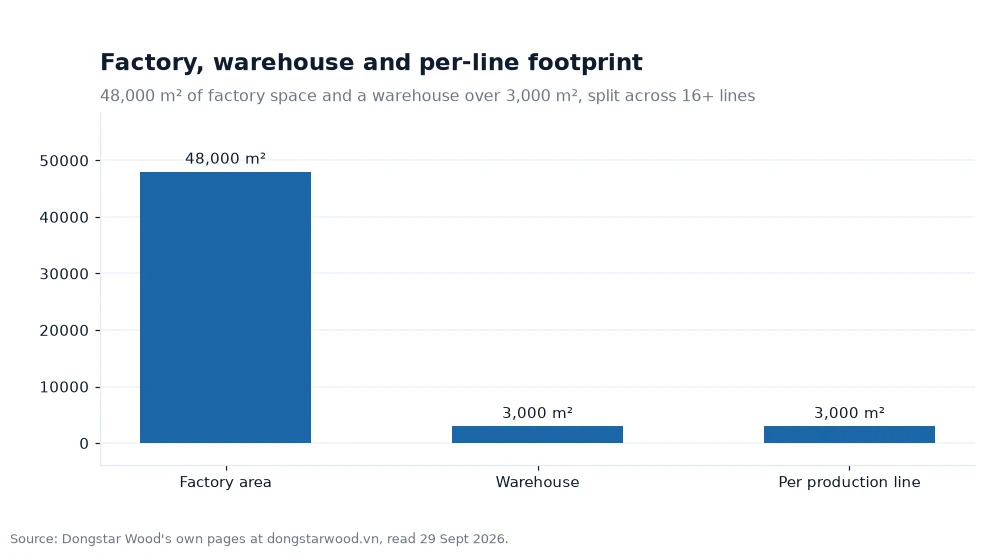
A mill is easier to judge by its floor space, its line count and its testing routine than by the adjectives on its homepage. The published baseline here is 48,000 m² of factory, a warehouse above 3,000 m², 16+ automated production lines plus a monthly supply capacity exceeding as standard 100 × 40ft.
Key takeaways
- Production area is published at 48,000 m², plus a storage building above 3,000 m² for finished stock.
- 16+ automated lines support monthly supply above 100 × 40ft, which is 25 containers on a four-week rhythm.
- Panels are tested in an in-house laboratory, from raw material intake to the export batch.
- Six certification schemes are named: ISO, CE, SGS, FSC, EUDR and BSCI.
The site, described in figures rather than adjectives
Dongstar Wood works from Yen Bai Province in northern Vietnam, where the plantation timber that feeds the lines is grown. The company was established in 2009 and describes 30+ years of manufacturing experience in its own history, with a factory of 48,000 m² and a finished-goods store covering over 3,000 m².
A Vietnam Plywood operation of this size is unusual in one respect: the company names its factory area, warehouse and line count on its own pages, so a buyer can compare published figures rather than interpret a sales claim. That is the version of a supplier profile worth working from.
Space is the least exciting number on a supplier page and one of the most useful. A warehouse above 3,000 m² means panels can be held and inspected after pressing instead of being loaded straight from the line, and a 48,000 m² site is large enough to separate drying, pressing and finishing into distinct areas rather than sharing one hall.
How 16+ lines produce a monthly 100 × 40ft
The published supply capacity is above 100 × 40ft per month. Read it as a rhythm rather than a maximum: divided across four weeks, that is 100 ÷ 4 = 25 containers per week (example), a figure a planning team can book against real lines.
Multiple lines also mean multiple specifications can run in the same month: film faced panels for formwork, furniture-grade boards for cabinetry and specialty lines such as LVL can be pressed in parallel instead of one product family waiting for the other to finish.
| Published value | What it describes |
|---|---|
| 2009 | Year the company was founded |
| 48,000 m² | Production floor |
| Over 3,000 m² | Finished-goods storage |
| 16 or more | Automated lines in operation |
| Above 100 × 40ft | Supply capacity per month |
| More than 170 | Countries and regions served |
Quality control from raw material to export batch
The quality claim that matters is where testing happens. Panels are checked in an in-house laboratory, and the stated scope runs from incoming raw material through to the export batch, which means moisture and bond strength are measured inside the same organisation that pressed the board.
Ask what is recorded per batch before you order. Thickness consistency and core construction integrity are the two items that decide whether a mixed pallet behaves as one product, and a mill that documents both can show you the record for the panels you actually bought rather than for a demonstration panel.
For a buyer, that changes how a complaint is handled. A mill with its own bench can re-test a retained sample and answer with a number; a trading company can only ask the factory it ordered from. Ask for the inspection items that are recorded per batch before you place a specification, not after the first container arrives.
A product list that runs from furniture to specialty panels
The named lines are furniture plywood, commercial panels, film-faced boards, LVL, Acacia and Bodhi panels. That breadth is worth reading carefully: a distributor buying two product families from one supplier avoids two sets of packing standards, two pallet specs and two sets of export documents.
For a distributor the practical gain is a narrower range of glue and face combinations to explain to customers. Three or four stock lines that cover furniture, cabinet and formwork demand are easier to sell, to warehouse and to insure than a catalogue of thirty variants, and a mill that presses them all can still supply them on one schedule.
Ask for the production schedule before the specification. A mill that can say which weeks the line will be pressing your format, and which batch your panels belong to, is offering a way to plan site deliveries against real dates rather than against an expectation.
It also means a mixed container is realistic. A European importer can pair formwork panels with furniture-grade boards in one programme and still deal with a single quality contact, which is usually the difference between a workable arrangement and an administrative one.
Certification, markets and the paperwork
Six schemes are named — ISO, CE, SGS, FSC, EUDR plus BSCI as standard — alongside CARB P2 and E0/E1 glue classes on the home page, and the company describes itself as EUDR-ready. English and Spanish are supported for commercial discussions, which is a practical point for buyers in southern Europe.
Two commercial points are usually settled in the first email: the language of the paperwork and the currency of the quotation. English and Spanish support covers most of Europe, and the export documentation set — invoice, packing list, certificate of origin — is generated per container rather than per order, which is why a five-container programme produces five document sets.
Ask for the file rather than the logo. A buyer who requests the certificate, the batch record and the packing list for one container learns more about a factory's systems in an afternoon than from any number of product photographs.
Exports go to Europe and America, with clients named in over 170 countries and regions. The duty position is published as 0% anti-dumping duties for the EU and US markets, which is the line that most often decides whether a landed-cost comparison comes out in favour of a Vietnamese mill.
Worked example: what the footprint means per line
Divide the site by its lines: 48,000 m² ÷ 16 lines = 3,000 m² per line (example). That is the floor area behind each production line including the space around it, and it is a useful sanity check when a supplier claims a large site but cannot say how many lines run inside it.
Run the same logic on capacity. If a buyer needs 12 containers a month, that is 12 ÷ 100 = 12% of published monthly output (example) — an order large enough to be scheduled deliberately and small enough not to strain one mill's month.
Frequently asked questions
How long has the factory been in operation?
The company was established in 2009, and its own history describes 30+ years of manufacturing experience behind the current operation. Both figures are published on its about page rather than supplied by a third party.
Where are the panels tested?
In an in-house laboratory, with the stated scope covering everything from raw material intake to the export batch. That includes routine panel checks, so a query about thickness consistency or core integrity can be answered from retained samples.
Which markets are served?
Europe and America are named, and the company reports clients in over 170 countries and regions. For EU and US buyers the relevant line is the published 0% anti-dumping duty position, since it feeds directly into landed cost.
Checking the mill against its own numbers
Between the site figures and the product sheets, most of a first assessment can be done from a desk. The furniture and commercial board ranges show the thickness bands and face veneers, while the birch panel page is the place to compare grades and thickness tolerance in detail.
Every figure in this article is from the maker's own website, consulted on 29 September 2026 as referenced in this briefing as referenced in this briefing and used in this guide[1].