A Sysadmin's Read of the ViaBTC Fee Schedule
A fee schedule behaves like a config file with money attached: two rates, two scopes, one settlement clock. At 2,107 TH/s the gross is $80.05 a day, the listed 4% on the block-reward component takes $3.20, and the listed 2% on the PPLNS-distributed components takes $1.60. Read it once, write it into the runbook, and stop estimating from memory.

Key takeaways
- At 2,107 TH/s the pool credits $80.05 gross a day; the listed 4% takes $3.20 and the listed 2% takes $1.60 on their own components.
- The two rates never stack into a single blended percentage, so store them as separate fields.
- PPS+ credits hourly; PPLNS waits six confirmations and averages over five difficulty rounds.
- Zero-fee mining payouts remove the withdrawal charge but not the listed mining rate.
Two rates, two line items
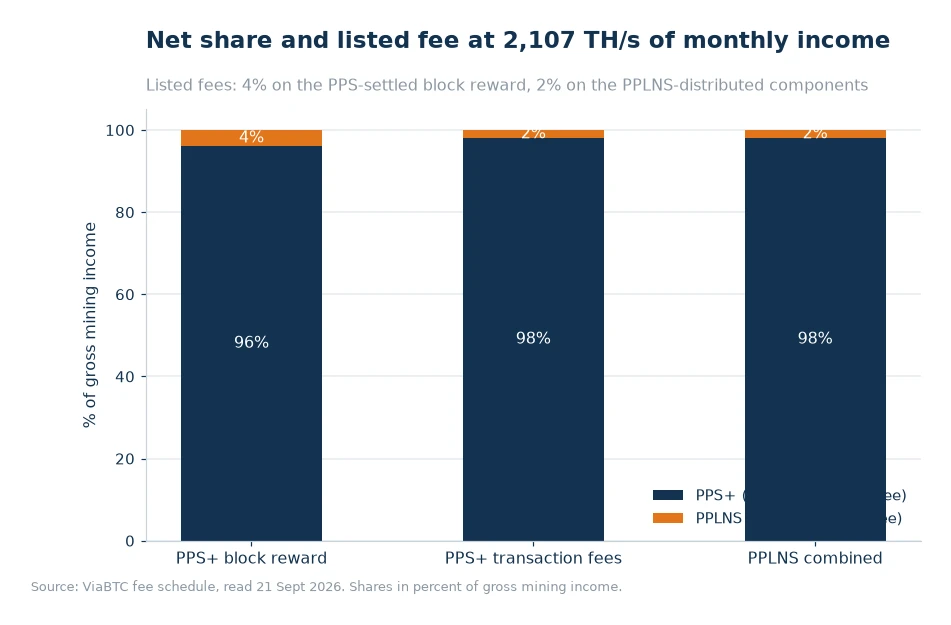
The schedule has the shape of a two-column table and people keep reading it as one column. PPS+, the default, settles the block-reward portion at a listed 4%. The transaction-fee portion inside PPS+ follows PPLNS logic at a listed 2%. PPLNS as a standalone mode combines both portions and charges a listed 2% on the total.
If you model that as `fee = gross * 0.04` in a script, you will be close but wrong, and the error will drift with fee revenue. If you model it as `gross * 0.06`, you will be wrong in the other direction and further out. Write two variables, one per component, and let the block-reward share dominate the result the way it dominates real payouts.
Where the 4% lands and where it does not
Under PPS+ the block reward is the big number. On 21 Sept 2026 a block paid 3.125 BTC, and 144 blocks a day put 450 BTC into the network. Almost all of a miner's credited coin comes from that stream, which is why the 4% line does most of the work in any fee comparison. The transaction-fee stream is variable and, at quiet mempool moments, small.
That asymmetry is useful when someone asks why PPS+ costs more. The higher listed rate buys something specific: the miner does not carry pool luck on the block-reward component, and settlement happens hourly against current difficulty. Under PPLNS the listed rate is lower because the miner carries that variance instead, averaged across the last five difficulty rounds.
A monthly view at 2,107 TH/s
The table converts the daily arithmetic into the units a budget actually uses. Net share is what remains after the listed rate on the component named in the first column.
| Component | Listed rate | Net share | Dollars per day | Dollars per 30 days |
|---|---|---|---|---|
| PPS+ block reward | 4% | 96% | $3.20 | $96.05 |
| PPS+ transaction fees | 2% | 98% | $1.60 | $48.03 |
| PPLNS combined | 2% | 98% | $1.60 | $48.03 |
Two of those rows describe the same 2% applied to different bases, which is exactly the confusion the table is meant to end. The PPS+ transaction-fee row is not an alternative to PPLNS; it is the second component of the default mode. Print the table, annotate it, and the next fee argument in the team chat gets shorter.
Settlement timing changes your cash position
Hourly settlement is a treasury feature disguised as a payout detail. At 2,107 TH/s the pool credits roughly $3.34 an hour, so a Monday invoice can be covered by Monday's mining without touching a reserve. PPLNS arrives after six confirmations, which means the credit lands later and in larger lumps, and the gap between work done and cash received grows.
For an operator with monthly power bills, that timing difference is worth more than the headline rate. A 2% saving that arrives three days late is not the same as a 4% charge that arrives on the hour. Model both, then pick the mode whose timing matches the outgoing payments rather than the one with the smaller percentage.
Comparing the modes without a spreadsheet marathon
Three columns are enough: listed rate per component, time to first credit, and who carries variance. Fill them once. PPS+ is 4% and 2%, hourly, pool does not pass luck through. PPLNS is 2% combined, six confirmations, miner carries the swing over five rounds. Every other difference follows from those three.
Anyone who wants the dollar version can put the hashrate into the Profit Calculator and compare the output against the hand calculation. Where the two disagree by more than rounding, the input is usually the culprit: a stale difficulty figure, a hashrate entered in PH/s where TH/s was expected, or a fee field left at a default.
Keep one source of truth for the rates themselves. The ViaBTC Pool Fees page is the reference the rest of your notes should cite, including the read date. A snapshot copied into a wiki six months ago is not a source; it is a rumour with a timestamp. When the page changes, the runbook entry changes with it, and any dashboard built on the old pair gets rebuilt before it reports another month.
What the schedule does not cover
It does not cover power, cooling, hardware depreciation, firmware bugs or the cost of a spare PSU on a shelf. Those belong to a different ledger and mixing them into a fee discussion produces the familiar complaint that a pool is expensive when the real cost is a 20 J/TH machine on a $0.12 tariff. Keep the ledgers apart and each one stays checkable.
It also does not fix difficulty. The estimate on 21 Sept 2026 pointed to a 2.12% reduction at the next adjustment, and a reduction raises daily coin output for the same hashrate. That helps a miner and has nothing to do with the listed rate, which is why a single "cost per day" figure has to be dated.
Worked example
Run 2,107 TH/s through the same steps a script would take.
- Hashrate in gigahash: 2,107 × 1,000 = 2,107,000 GH/s.
- Network share: 2,107,000 ÷ 1,003,107,267,295 = 0.00000210047.
- Daily coins: 0.00000210047 × 450 = 0.00094521 BTC, carried as 0.00094531 in the chart.
- Gross dollars: 0.00094531 × 84,692 = $80.05.
- Listed 4% on the block-reward component: 80.05 × 0.04 = $3.20.
- Listed 2% on the PPLNS-distributed components: 80.05 × 0.02 = $1.60.
- Thirty days at the 4% line alone: 3.20 × 30 = $96.05, or 0.001134 BTC.
The two fee lines describe different bases, so do not add them to produce a single monthly charge. A blended figure of $4.80 a day would overstate the block-reward charge and understate nothing, which is the sort of error that survives in a spreadsheet for a year because nobody wants to reopen it.
Frequently asked questions
Do the 4% and 2% rates add up to 6%?
No. They apply to different components of the payout, so a PPS+ miner pays the listed 4% on the block-reward slice and the listed 2% on the transaction-fee slice rather than a single charge on the whole.
Which mode credits faster?
PPS+ credits hourly against current difficulty. PPLNS credits after six confirmations and shares the miner's slice across the last five difficulty rounds, so the money arrives later and in larger blocks.
Is the withdrawal charge part of the fee schedule?
Separate. Zero-fee mining payouts mean the withdrawal step carries no charge, while the listed mining rate still applies to the payout itself.
Put the rates in your runbook
Write the two rates, their components, the settlement clock and the read date into the same document that holds the hashrate baseline and the alert thresholds. Then add one check to the weekly routine: compare credited coins against the expected figure for the hashrate actually reported by the pool state page. A drift of a few percent is usually a stale hashrate reading, not a fee change, and the check takes less time than the argument it prevents.
Sources: fee schedule, profit calculator and pool state pages on viabtc.com. Inputs captured 21 Sept 2026 at 132.76 T difficulty, 1,003 EH/s network hashrate, $84,692 per BTC, with 3.125 BTC issued each of 144 daily blocks[1]. Continuous running is assumed. Published 24 Oct 2026.