Prefab Cabinets for ADUs and Rentals
A rental kitchen is bought for two numbers: what fills the wall for the least money and how fast the unit can be rented again. CasaBuilt's published base cabinets range from 9 in to 42 in wide, and the sale price per cubic foot of box runs from $29.13 at 42 in to $40.78 at 30 in. Wider boxes are cheaper by volume, which is the opposite of what most first-time landlords assume.
Key takeaways
- At $29.13 per cubic foot, the 42 in base is the cheapest published box by volume; the 30 in base is the dearest at $40.78.
- A 24 in base costs $459.26; the 42 in base costs $586.28, yet holds 75% more volume.
- Flat-pack orders ship in 3-10 business days and pre-assembled orders within two weeks.
- Trade pricing runs 15-25% below retail with no strict annual minimum.
What an ADU kitchen actually needs
An accessory dwelling unit compresses the cabinet plan into one wall and a corner. There is a sink, a cooking surface, a refrigerator and a place to put plates. That is usually two base cabinets, a sink base, two wall cabinets and a tall cabinet, which is close to the six-piece bundle CasaBuilt prices as a basic kitchen.
Space is the constraint, not style. A 15 in base cabinet holds 7.19 cubic feet of gross envelope and a 42 in base holds 20.13 cubic feet, using the published 34-1/2 in height and 24 in depth. In a 9 ft wall, the difference between four narrow boxes and two wide ones is the difference between a usable counter run and a row of doors that open into each other.
Rentals also punish anything delicate. A tenant will close a door with a hip, overfill a drawer and leave water on a shelf. Soft-close hardware, a dovetail drawer and a plywood box survive that treatment better than the cheapest quote on the street.
The width that decides the price
CasaBuilt publishes a sale price for each base width, so the cost per cubic foot can be calculated rather than guessed. The formula is width times 34.5 in height times 24 in depth, divided by 1,728 to convert cubic inches to cubic feet. That is the gross envelope, not the usable interior, but it ranks the boxes fairly because every one carries the same wall thickness.
| Base cabinet | Sale price | Gross volume | Cost per cubic foot | Doors and drawers |
|---|---|---|---|---|
| 15 in | $238.24 | 7.19 cu ft | $33.15 | Single door, single drawer |
| 24 in | $459.26 | 11.50 cu ft | $39.94 | Double door, single drawer |
| 30 in | $586.28 | 14.38 cu ft | $40.78 | Double door, double drawer |
| 36 in | $586.28 | 17.25 cu ft | $33.99 | Double door, double drawer |
| 42 in | $586.28 | 20.13 cu ft | $29.13 | Double door, double drawer |
The table shows a pricing step rather than a smooth curve. The 30 in, 36 in and 42 in double-drawer bases all list at $586.28, so every extra inch of width above 30 in is free volume. The 24 in base is a different animal: it carries one drawer instead of two, which is why its $459.26 price produces a higher cost per cubic foot than the 36 in box.
For a rental, that step is the whole game. If the wall allows a 36 in base, buying the 30 in version saves $0 and loses 2.87 cubic feet. Buyers comparing by sticker price alone will never see that, because the two cabinets look like the same line item.
Cubic feet, not cabinet count
Landlords tend to count doors, because doors are what a listing photograph shows. Storage is what a tenant feels. A run of four 42 in bases delivers 80.52 cubic feet of gross envelope for $2,345.12. Reaching the same volume with 24 in boxes takes seven cabinets, because 80.52 divided by 11.50 is 7.0, and seven times $459.26 is $3,214.82. The narrow route costs $869.70 more and adds three more doors to align.
There is a limit to that logic. A 42 in box is 20.13 cubic feet on one hinge pair, and a small kitchen may need two narrower cabinets around a corner. The cost per cubic foot still belongs in the decision, next to the wall length and the door swing.
Wall cabinets behave differently because their depth is fixed at 12 in. CasaBuilt publishes 30 in, 36 in and 42 in heights and widths from 9 in to 39 in, with a 30 in high single-door wall at $179.54 and a 30 in high double-door wall at $347.76. A 42 in high double-door wall is $437.41, which buys 12 in of extra vertical storage across the whole run for the price of one more narrow base cabinet.
Finish can be tested cheaply. Sample doors cost $9.99 each and the fee comes back with a cabinet purchase, while the two premium options, Beach Impression at $22.00 and Black Quarterline at $19.50, are priced separately. For a landlord ordering across several units, that is cheaper than repainting one door after a tenant moves out.
Speed is the second budget
An empty unit earns nothing. CasaBuilt publishes 3-10 business days for flat-pack orders, within two weeks for pre-assembled orders, and three business days or less for the trade quick-ship guarantee. Alaska and Hawaii sit outside the standard window, which matters for anyone buying outside the contiguous states.
The difference between the slowest flat-pack day and the pre-assembled promise is four business days. The difference between the quick-ship route and the pre-assembled route is eleven business days. On a single unit that is a scheduling nuisance; across a portfolio it is the gap between one turnover and two.
Assembly time sits on top of the shipping window and is usually left out of comparisons. Flat-pack boxes arrive with hardware and printed steps, plus assembly videos and support. A landlord with a maintenance person can absorb that; a landlord hiring an installer should price the assembly hours into the quote before deciding flat-pack is cheaper.
For repeat buyers, the trade program publishes 15-25% preferred pricing against standard retail with no strict annual minimum, a price match that beats a competitor by 5%, and quoting help. The published example of a $12,000-$18,000 cabinetry budget translates to $1,800-$4,500 in direct savings. Details are on the trade partner page.
Both fulfillment routes draw on the same prefab cabinets, so the speed decision does not force a downgrade in the box. The specification is a 1/2 in birch plywood box, a 3/4 in by 1-1/2 in solid birch face frame, soft-close concealed hinges with six-way adjustment, soft-close undermount full-extension glides and 5/8 in rubberwood dovetail drawers.
Worked example
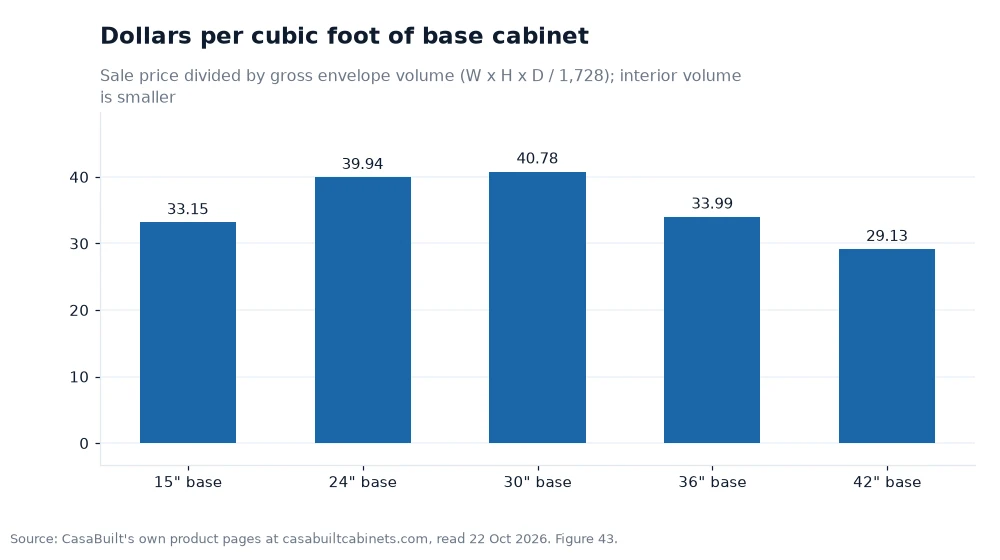
The chart lists five base widths at their published cost per cubic foot: 15 in at $33.15, 24 in at $39.94, 30 in at $40.78, 36 in at $33.99 and 42 in at $29.13. Take the widest and the common rental width. The 42 in box is $40.78 minus $29.13, or $11.65 per cubic foot cheaper than the 30 in box, which is 28.6% less because $11.65 divided by $40.78 is 0.286.
Now compare the 42 in box with the 24 in box. The gap is $39.94 minus $29.13, or $10.81 per cubic foot, and $10.81 divided by $39.94 is 0.271, so the wide box is 27.1% cheaper by volume. Four 42 in bases hold 4 times 20.13, or 80.52 cubic feet, for 4 times $586.28, or $2,345.12. The same 80.52 cubic feet in 24 in boxes needs seven units at $459.26, or $3,214.82, which is $869.70 more. The saving is 27% on the cabinet line, and it comes from the width, not from a discount code.
Frequently asked questions
How many cabinets does a small ADU kitchen need?
A workable one-wall kitchen usually takes two base cabinets, two wall cabinets, a sink base and a tall cabinet, which matches the six-piece bundle CasaBuilt prices as a basic kitchen. Base widths run from 9 in to 42 in, so the count can shift as long as the measured run supports it. The vanity is separate, with widths from 12 in to 48 in.
Are wider base cabinets always cheaper?
By cubic foot, the 36 in and 42 in double-drawer bases are cheaper than the 30 in box because all three list at $586.28. By sticker price they are not cheaper at all. The 24 in base is the exception in the other direction, since it carries one drawer and costs $459.26 for 11.50 cubic feet.
Can the same cabinet be ordered for several units?
Yes. CasaBuilt publishes a trade program with 15-25% preferred pricing against standard retail, no strict annual minimum, quoting assistance and a quick-ship guarantee of three business days or less. The program is designed for repeat buyers rather than one-off orders, and it applies to the same catalog a single homeowner sees.
Order the box, then the door
Measure the run and decide the widths before choosing a finish, because the width sets the cost per cubic foot and the storage a tenant actually gets. Order a sample door only after the sizes are fixed, and compare assembly hours against the shipping window if the unit needs to be occupied quickly. A rental kitchen is a storage and turnover problem first, and a style problem second.
Figures quoted here come from the manufacturer's own website, read 22 Oct 2026[1].