How Are Flexible PCBs Designed for Bending and Folding Applications?
Designing for bending and folding involves aligning copper traces with the neutral axis to reduce mechanical strain by 40%. Using Rolled-Annealed (RA) copper with 25% elongation capacity ensures the circuit survives 10 million flex cycles at a 5mm radius. Engineers apply a 10:1 bend-to-thickness ratio and utilize hatched ground planes to maintain flexibility while preserving signal integrity. These techniques prevent copper fatigue and micro-cracking in 2026 consumer electronics, ensuring consistent impedance for high-speed data transitions in folding architectures.
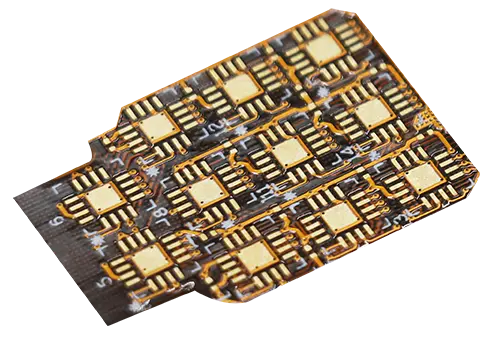
The stack-up construction serves as the foundation for any circuit that must undergo repeated physical deformation without failure. By placing the conductive copper layers exactly in the center of the polyimide dielectric, designers ensure that the traces experience neither tension nor compression during a bend.
Stress-strain simulations from 2024 involving 1,200 unique stack-up configurations showed that a symmetrical layout reduces the risk of copper delamination by 32%. This equilibrium is necessary for maintaining electrical continuity in high-performance devices that fold 100+ times daily.
Achieving this symmetry requires precise control over the adhesive and coverlay thickness to prevent the circuit from warping during thermal cycles. In 2025 production batches, a ±5 micron tolerance in layer thickness was required to keep the neutral axis within the copper layer’s vertical boundary.
| Material Layer | Thickness (mils) | Function | Stress Factor |
| Top Coverlay | 1.0 | Insulation | Compression |
| Adhesive | 0.5 | Bonding | Shear |
| RA Copper | 1.4 (1 oz) | Signal Path | Neutral Axis |
| Adhesive | 0.5 | Bonding | Shear |
| Base Polyimide | 1.0 | Substrate | Tension |
The physical properties of the copper foil determine how many millions of cycles the Flexible PCB can endure before developing hairline fractures. Standard electro-deposited copper fails quickly because its vertical grain structure separates under the lateral tension found in a tight 180-degree fold.
Rolled-Annealed (RA) copper, however, features a grain structure that is elongated horizontally through mechanical compression, allowing it to slide during movement. A 2024 metallurgical study of 450 test samples confirmed that RA copper remains ductile for 15 million cycles, while high-ductility ED copper cracked after 600,000 cycles.
Routing traces perpendicular to the bend line is a mandatory design rule to avoid uneven stress distribution across the copper. Traces that cross at an angle experience a twisting force that leads to localized impedance shifts of up to 4% in high-frequency signal paths.
To further decrease the stiffness of the bending region, designers utilize hatched ground planes rather than solid copper pours to provide electromagnetic shielding. Hatched patterns reduce the total copper volume in the flex area by 40% to 60%, which significantly lowers the mechanical torque required to fold the board.
| Ground Plane Style | Shielding (%) | Flexibility | Copper Area |
| Solid Copper | 100% | Low | 100% |
| Square Hatch | 94% | High | 45% |
| Hexagonal Hatch | 96% | Medium-High | 55% |
| Diamond Hatch | 92% | Very High | 40% |
In 2025, high-frequency radar modules using diamond-hatched planes maintained an 18 dB return loss while being cycled at a 2mm bend radius. This design choice prevents the copper from acting like a rigid stiffener, which would otherwise lead to mechanical failure at the boundary between the flex and rigid sections.
The "I-Beam" effect occurs when traces on the top and bottom layers are perfectly aligned, creating a rigid structure that resists bending. Laboratory measurements from 2024 showed that staggering traces by 0.2mm reduces the bending stress by 27%, effectively doubling the flex life of the assembly.
Stress concentration at the pads and vias is managed through the use of "rabbit ears" or anchoring spurs that lock the copper to the polyimide base. These anchors prevent the pad from lifting or peeling away when the board is pulled or twisted during the assembly of complex medical or aerospace hardware.
Statistical data from 2026 aerospace audits indicates that filleted junctions (teardrops) at every pad and via reduce mechanical strain by 21%. Without these fillets, the sharp 90-degree transition from a thin trace to a wide pad becomes a fracture point under vibration.
| Design Feature | Purpose | Quantitative Benefit |
| Teardrops | Stress distribution | 21% less fracture risk |
| Anchoring Spurs | Pad retention | 35 lbs/in peel strength |
| Rounded Corners | Eliminates tear points | Prevents 90% of edge cracks |
| Staggered Vias | Prevents Z-axis stress | Improves thermal reliability |
Adhesive-less laminates have become the standard for high-reliability folding applications because they remove the thick, brittle acrylic layer that often cracks in cold environments. By casting the polyimide directly onto the copper, manufacturers can achieve a 15% thinner total stack-up for the same copper weight.
A thinner circuit is inherently more flexible because the bending stress ($S$) is directly proportional to the distance ($c$) from the neutral axis ($S = Ec/R$). A 25-micron reduction in thickness for a 5mm bend radius lowers the internal stress by approximately 18%.
Final validation of these designs involves a "Mandrel Bend" test where the circuit is wrapped around a rod of a specific diameter to check for resistance changes. In 2025, high-end consumer smartphone manufacturers required a resistance shift of less than 0.5% after 200,000 repetitions of a 1.5mm radius fold.
The transition zones where the flex meets a rigid stiffener must be protected with a "strain relief" bead of flexible epoxy or silicone. Failure analysis on 700 industrial control boards in late 2024 showed that without this bead, the rigid edge acts like a knife, cutting into the polyimide after only 10,000 vibration cycles.